

Summary
As the war in Ukraine drags into its third year, the Russian digital ecosystem continues to portray NATO not as a defensive alliance, but as the very core of an aggressive, Western-led conspiracy. Over the past three months (September–November 2025), a new analysis conducted by Adi Constantin, expert at the Center for Civic Participation and Democracy (CPD) at SNSPA, based on over 12,000 mentions in Russian online media outlets (excluding social media), reveals a structured, emotionally charged, and strategically disciplined narrative campaign aimed at delegitimizing NATO’s role in the region. The analysis was conducted using the NewsVibe platform. The extended report was presented at the Bucharest Security Conference, as part of the panel “Hybrid Threats and the Resilience of the Liberal Order – Lessons from Disinformation and Polarization in 2024 & 2025”.
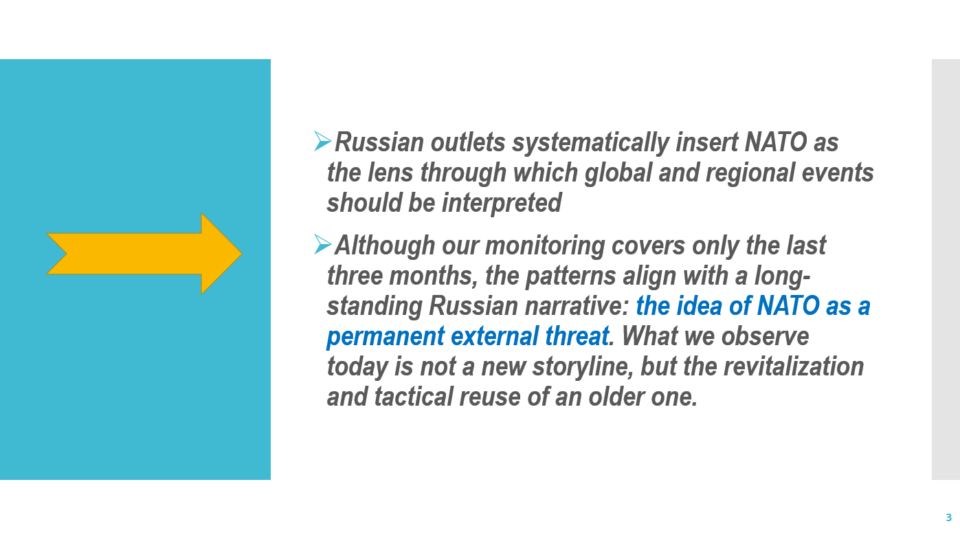
What emerges from the data is not a chaotic mix of opinions or events, but a deliberately repeated storyline, shaped across a network of online sources and designed to anchor Russia’s position as victim and resistor in the face of a hostile Western bloc. NATO is not simply mentioned—it is framed consistently as the organizing symbol of a global campaign of pressure, interference, and escalation.
The narrative structure: discipline over noise
The Russian narrative ecosystem presents a remarkably stable pattern in how it references NATO. The timeline of topic surges (p. 8) shows that even though weekly spikes in mentions occur in reaction to major events—such as peace talks or military incidents—the same clusters of themes recur throughout the entire monitored period.
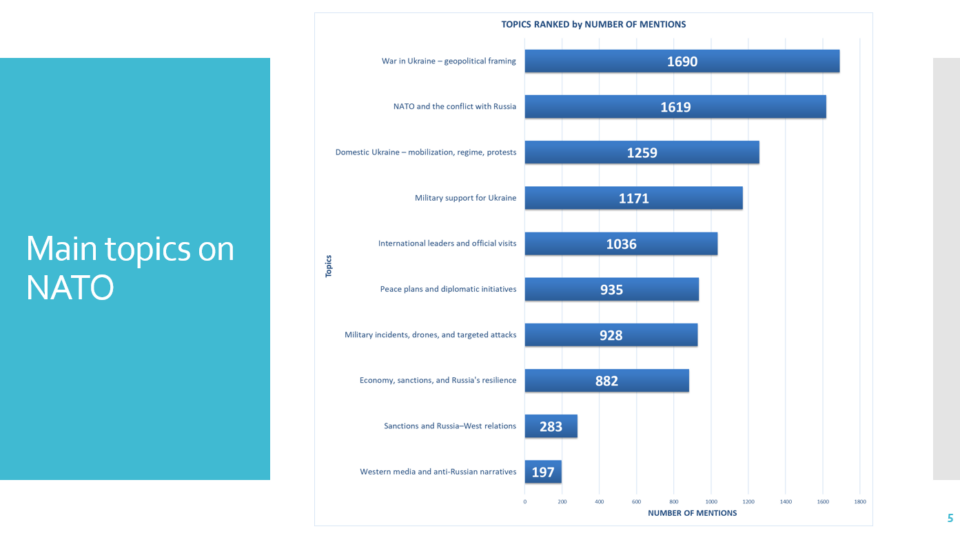
The top topics include:
- The war in Ukraine as a geopolitical East–West confrontation,
- NATO’s latent conflict with Russia,
- Military support for Ukraine, and
- Western sanctions and economic warfare
Together, they shape a polarized world in which Russia is under siege and NATO is seen not as a guarantor of peace, but as the principal engine of instability.
Sentiment Framing: cold neutrality, hot emotions
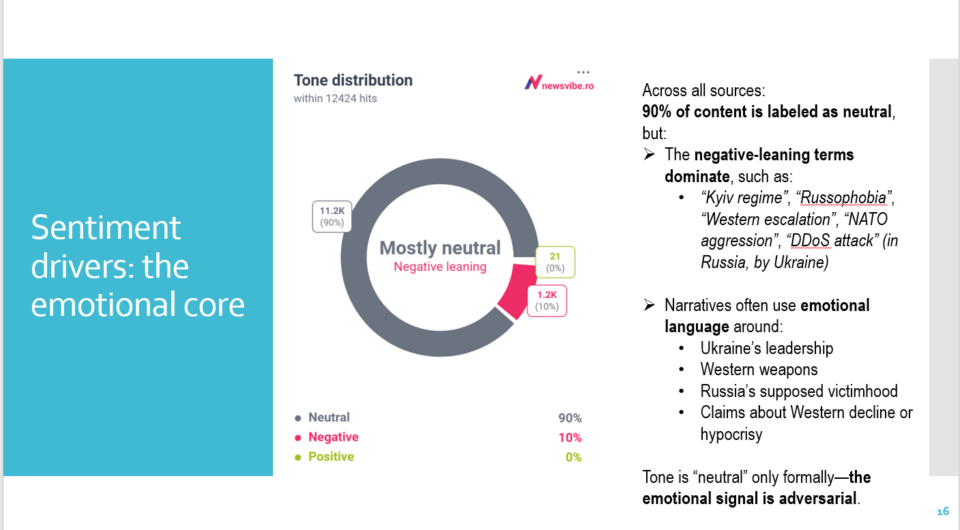
Despite 90% of content being labeled as “neutral” in tone, a closer look reveals an unmistakable emotional strategy. The semantic analysis and sentiment maps (pp. 15–18) show that:
- Negative emotional language clusters around terms like “NATO aggression”, “Kyiv regime”, and “Russophobia”;
- Positive sentiment is reserved almost exclusively for domestic actors (Putin, Russian Armed Forces), even when Russia is discussed in tense or conflictual contexts;
- NATO, Ukraine, the EU, and the US are constantly framed as external aggressors, fueling escalation.
This dual logic—externalizing blame, internalizing pride—is a classic feature of strategic propaganda and reinforces the idea of a just, resilient Russia facing unfair and coordinated attacks.
Who appears with NATO? Semantic and network signals
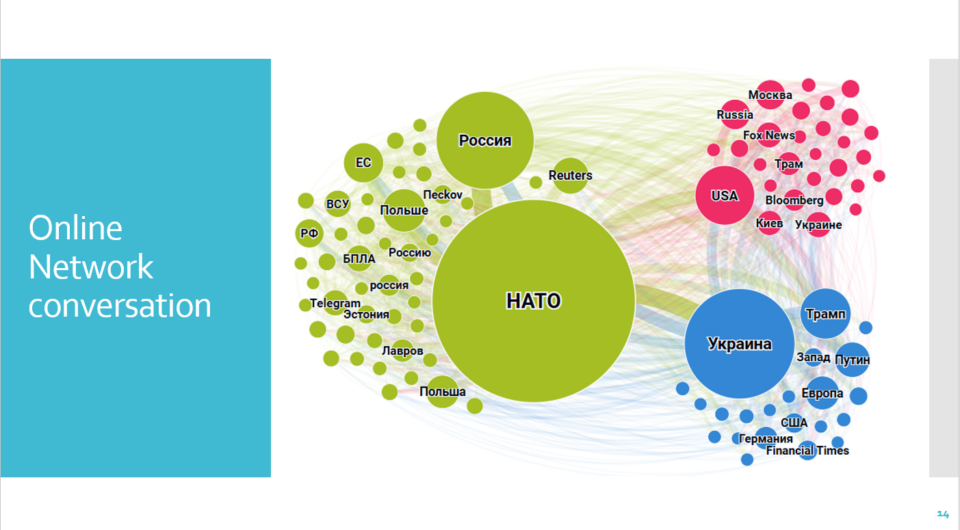
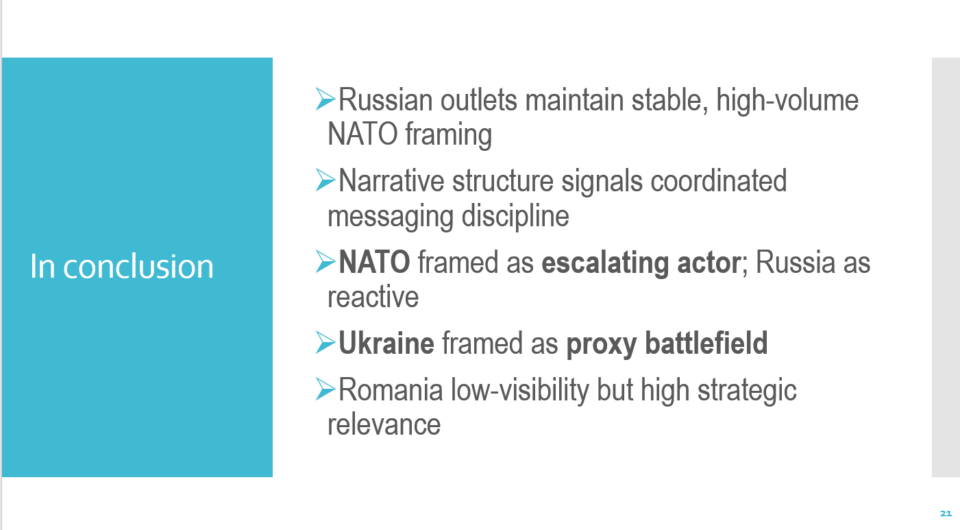
The semantic clouds and conversation network diagrams (pp. 9–14) further reveal how tightly interwoven the NATO label is with other symbols of Western power: the US, Ukraine, the EU, and major Western media outlets. The strongest narrative link remains between NATO and Russia itself, often in a direct binary opposition. Meanwhile, Ukraine is portrayed primarily as a battlefield or a proxy, rather than an autonomous actor.
Interestingly, countries like Poland and Estonia have gained visibility in the past months as perceived “frontline” provocateurs. In contrast, Romania is mentioned in less than 1% of all references, though almost always within strategically sensitive contexts—troop deployments, intelligence sharing, or surveillance infrastructure.
Why it matters: narrative power in hybrid confrontations
This analysis is not just about media monitoring. It reflects the frontline of a broader informational confrontation, where perception management is a crucial domain of hybrid warfare. Understanding how NATO is framed in Russian narratives can help Western actors—especially in frontline states like Romania—develop better strategic communication responses.
In particular:
- Narrative discipline is a powerful weapon. The Russian digital space shows a high degree of coordination in pushing the same core frames, regardless of external events.
- Emotional undertones matter more than stated tone. The sentiment may appear “neutral,” but the actual effect is to escalate distrust and justify confrontation.
- Regional actors like Romania remain under the radar, but their involvement is no less strategic. Even low-visibility mentions can play a role in escalation scenarios.
Conclusion: resilience requires awareness
As the conflict continues and peace negotiations remain uncertain, the ability to decode adversarial narratives becomes a strategic necessity. Monitoring, understanding, and responding to such campaigns—especially when they target institutions like NATO—is essential to safeguarding not just reputations, but national and regional stability.
This report is part of an ongoing effort to strengthen narrative literacy in democratic societies, offering a case study in how hybrid conflict is fought also in headlines, hashtags, and hyperlinks.