
Summary
The recently-released report UNESCO World Trends in Freedom of Expression and Media Development 2022–2025 documents a sustained global decline in press freedom, growing pressure on media viability and the profound impact of digital technologies on journalism and democratic life. Since 2012, the global Freedom of Expression Index has fallen by 10%, associated with rising hostility toward journalists and the rapid spread of disinformation, increasingly amplified by artificial intelligence.
A central analytical component of the report is Chapter 2 – Journalism: Bridging the Promise and Threat of Technology, co-authored by Dan Sultănescu, Research Director at the Center for Civic Participation and Democracy (CPD) with SNSPA, based on a collaboration that includes the University of South Carolina College of Information and Communications in the United States. The chapter examines how emerging technologies – particularly AI-driven systems – are reshaping journalism, public trust and information integrity.
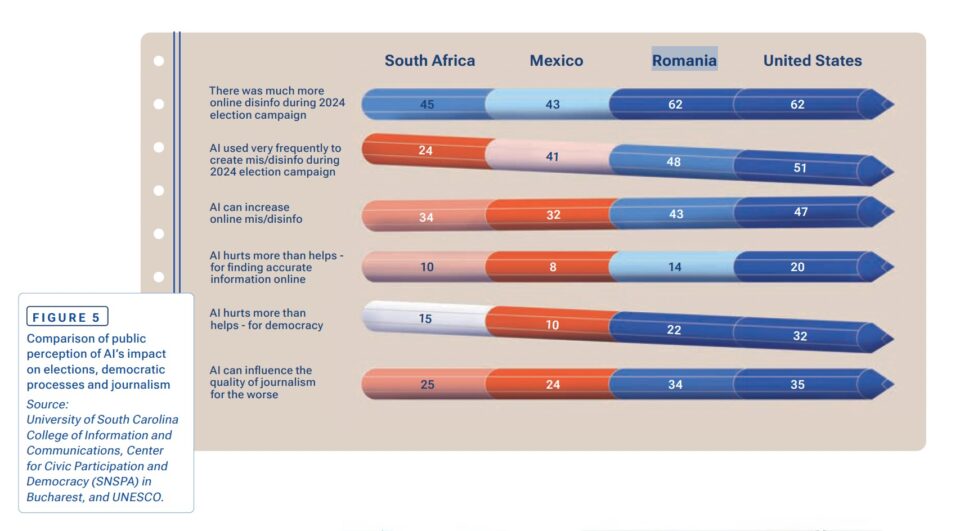
The analysis in this chapter is grounded in a four-country public opinion survey coordinated by Dan Sultănescu (in the United States, Romania, Mexico and South Africa), which explored awareness of artificial intelligence, perceptions of its impact on journalism, elections and democratic processes, as well as levels of trust in different information actors and institutions. The survey results are compared to actual information-seeking behavior, offering empirical evidence on how audiences engage with technology-mediated news environments.
The four-country comparison further shows that perceptions of AI’s impact on journalism and elections differ significantly across countries, as does confidence in the actors seen as responsible for managing these technologies. For example, the four-country survey shows that concern about AI-driven election disinformation was markedly higher in both Romania and the United States, where 62% of respondents reported noticing much more online disinformation during the 2024 election campaigns, compared with 45% in South Africa and 43% in Mexico.
Dan Sultănescu’s contribution to the World Trends Report reflects CPD’s involvement in international research efforts focused on the relationship between technology, public opinion, democratic participation and communication. By anchoring the analysis in coordinated cross-national survey data, the chapter adds empirical depth to global debates on artificial intelligence, journalism and freedom of expression.
The full report can be read here: UNESCO WORLD TRENDS REPORT