

Summary
How visible are Romania’s public institutions in the digital space, and what drives their presence? CPD’s quarterly Institutional Radar tracks mentions and estimated audience reach across online news, Facebook, YouTube, and TikTok, offering a data-driven picture of the institutions shaping public conversation.
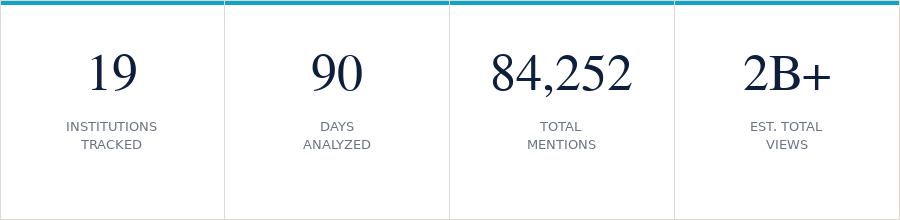
The winter 2025–2026 edition covers 19 central public institutions over a 90-day period, using social listening methodology to measure both raw mention volume and cumulative estimated impact, a metric that captures how widely content about each institution circulates online. Judicial institutions were the most visible actors of the period, driven by criminal investigations, high-impact rulings and a months-long debate on magistrates’ pensions.
Justice sets the agenda
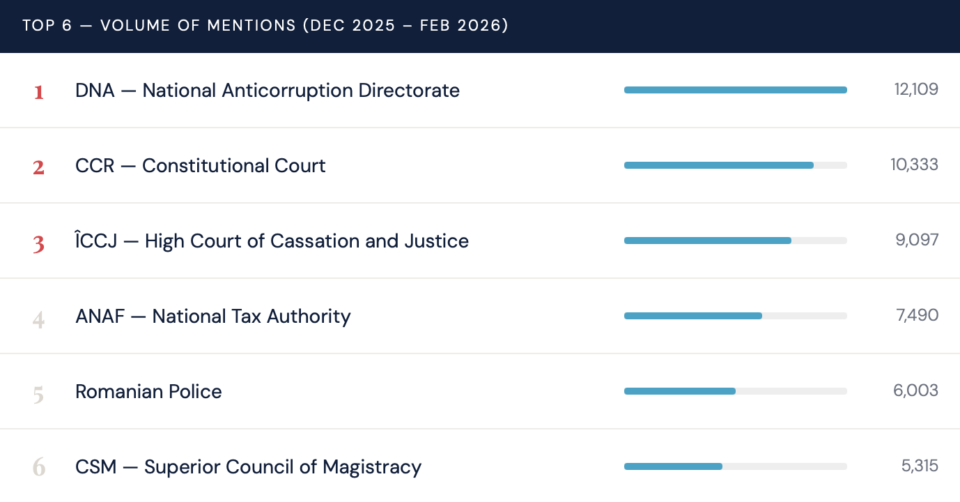
The top three institutions by both mentions and estimated impact are all from the justice and constitutional domain: DNA leads with over 12,000 mentions and nearly 270 million views, followed by the Constitutional Court (CCR) and the High Court of Cassation and Justice (ÎCCJ). The debate around magistrates’ pensions acted as a sustained, cross-institutional thread, generating spikes across CCR, ÎCCJ, CSM, and the Government simultaneously.
Visibility is concentrated around public-interest events
For most institutions, visibility concentrates in one or two narrow windows across the entire 90-day period. DNA peaked sharply in mid-December and again in early February; CCR spiked four separate times, each tied to a distinct ruling on the same piece of legislation. The pattern is consistent across the ranking: brief, event-driven surges followed by a return to low baseline activity. Most institutions show brief, event-driven surges rather than a consistently elevated baseline throughout the period.
What the full report covers
Beyond the judicial cluster, the report profiles each of the 19 institutions individually – tracking their peak visibility moments, the events behind them and the sources driving their reach. Notable findings include the Romanian Police’s strong local-media footprint, CSM’s emergence as a top-five institution by impact, and the persistently low visibility of the Senate, the Ombudsman, and the Presidency.
Outside the political cycle
The Romanian Police stands out for a structural reason: more than half of its over 6,000 mentions originate from local news sources, a pattern distinct from most other institutions in the study. Its visibility is generated not by central political dynamics but by operational, proximity-based events – traffic alerts, regional crime cases, weather-related incidents.
CSM – the Superior Council of Magistracy – ranks 6th in mentions and 5th in estimated impact (over 150 million views), ahead of institutions with considerably higher political salience such as the Government. Its visibility was driven primarily by reactions to an investigative documentary and its institutional response to the President’s proposal for a justice referendum.
Methodology
The Institutional Radar uses social listening data sourced from Newsvibe.ro, aggregating content from online news sites, Facebook pages, YouTube channels, and TikTok accounts. The study measures two distinct indicators: the volume of mentions (number of articles or posts referencing each institution) and cumulative estimated impact (the aggregate estimated audience of all content mentioning the institution). The analyzed period runs from December 1, 2025 to February 28, 2026.
The full report is available via the link in the right-hand panel.
The articles published on civicparticipation.ro solely reflect the views of their authors and do not represent SNSPA’s official position.