
Summary
We live in an era where geopolitics is no longer confined to closed-door negotiations; it dominates our screens, shapes our social media feeds and dictates the daily news cycle. But when we strip away the noise, which global actors truly capture the public’s attention, and what hidden narratives shape our perception of them?
The team at the Center for Civic Participation and Democracy (CPD-SNSPA) has just released volume 2/2025 of the Geopolitical Spotlight report. The report offers a comprehensive digital X-ray of how 10 major global actors – the US, Russia, Ukraine, the EU, NATO, Germany, France, the UK, Israel and China – are reflected in the Romanian online and social media landscape during the second half of 2025.
Going beyond surface-level metrics, the data reveals a complex web of platform biases, soft power victories and semantic trends. Here are the most striking insights from the new report:
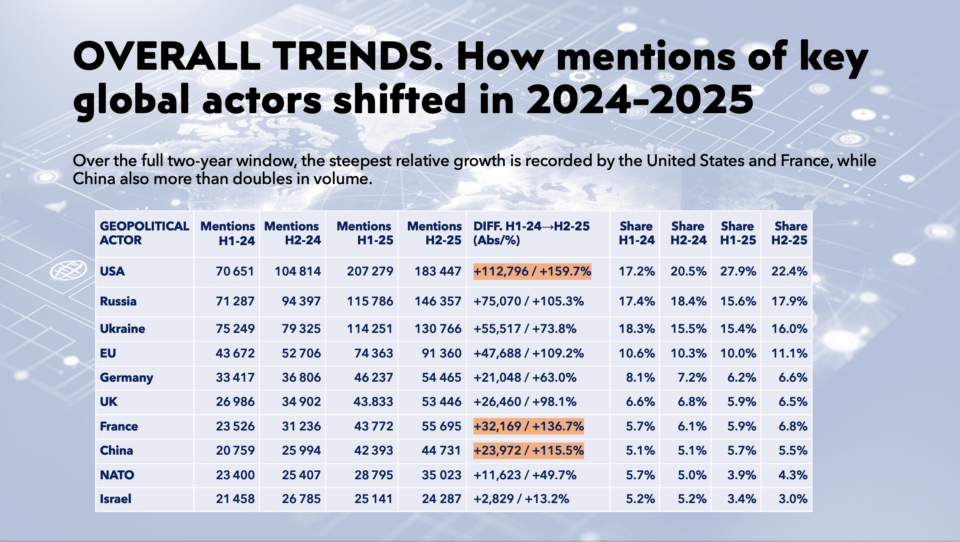
1. An unprecedented explosion in geopolitical interest. The sheer volume of online conversations surrounding global actors has skyrocketed. The report tracks a massive surge from roughly 410,000 mentions in the first half of 2024 to roughly 820,000 mentions in the closing half of 2025. Unsurprisingly, the narrative is monopolized by a dominant triad: the United States, Russia and Ukraine account for approximately 56% of the total visibility share. Their upward trajectory is heavily fueled mainly by the ongoing dynamics of the Russia-Ukraine war.
2. The conflict-driven agenda vs. the soft power champions. The baseline tone of the Romanian digital space is inherently penalized by the harsh lexicon of global crises. News cycles are driven by the Russia-Ukraine and Israel-Gaza conflicts, meaning that the overall sentiment scores of actors like the US, EU, NATO, Israel and Ukraine are pushed into the negative by this war lexicon.
However, there are exceptions. The UK and Germany are the only geopolitical actors to record a net positive sentiment, their digital footprint being driven by constructive bilateral diplomacy, high-level official visits, economic cooperation reflected during the analyzed period.
3. The “Donald Trump Effect”: the ultimate geopolitical connector. President Trump emerges as the absolute common denominator in the Romanian geopolitical discourse. His name uniquely penetrates the semantic networks of all ten actors analyzed – from discussions regarding China and Russia to the institutional future of the EU, NATO and Israel. No other global leader manages to cross over into every single geopolitical bubble so consistently.
4. The rule of impact. The report uncovers a stark contrast between raw volume and actual audience reach. While the US and Russia generate an overwhelming number of mentions, European states like France and the UK demonstrate astounding digital efficiency. With a fraction of the mentions, articles and posts about France and the UK generate colossal audience reach, averaging tens of thousands of views per mention.
5. The platform battleground. Digital diplomacy is not one-size-fits-all; the tone and reach shift radically depending on the network. The report highlights some platform asymmetries:
- The TikTok advantage: for actors like China, Germany and Israel, TikTok generates a higher audience impact (reach) than YouTube.
- The YouTube advantage: conversely, for actors like France, the UK, Russia and NATO, YouTube outperforms TikTok in terms of total reach.
- The sentiment asymmetry: platforms also dictate the tone of the conversation. YouTube acts as the most negative environment for the EU, NATO and China. Meanwhile, Facebook remains the most hostile platform for Russia, presenting a significantly higher negative tone compared to traditional web media.
- The undisputed web dominance: while video platforms show unique engagement and sentiment trends, traditional web sources remain the absolute powerhouse of geopolitical visibility. The vast majority of both mentions and audience reach occurs on news portals and websites. In fact, while TikTok and YouTube generate reach in the tens of millions, the web drives the true mass-market impact, with actors like France and the UK exceeding one billion views exclusively through traditional online media.
Discover the full analysis in the attached report, which includes the complete data sets, regional heat maps and long-term visibility patterns.
The articles published on civicparticipation.ro solely reflect the views of their authors and do not represent SNSPA’s official position.