

Summary
At first glance, European affairs occupied only a marginal place in Romania’s online conversation during June 2026.
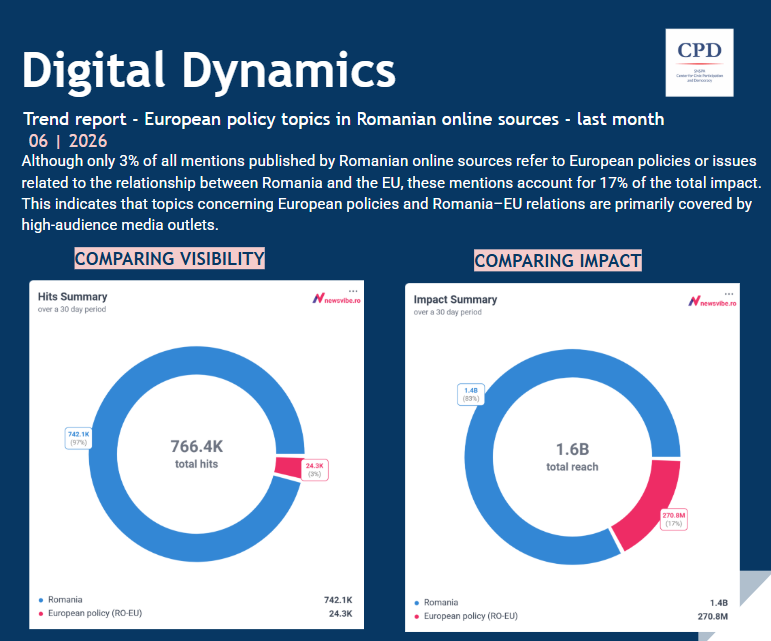
Only 3% of all online mentions referred to European policies or to Romania’s relationship with the European Union. Yet these discussions generated 17% of the total online impact, revealing a striking imbalance between visibility and influence.
This is perhaps the most important finding of the latest Digital Dynamics report produced by the Center for Civic Participation and Democracy (CPD).
The data suggests that European issues may not dominate the daily news agenda, but when they do emerge, they are amplified by Romania’s largest media outlets, reaching significantly larger audiences than their numerical share would normally indicate.
Small volume, high visibility
Digital attention is often measured through the number of mentions. However, visibility alone rarely tells the full story.
The June data illustrates precisely this distinction.
Topics related to European policies represented only a small fraction of Romania’s overall online conversation. Nevertheless, they generated almost one-fifth of the total projected reach because they were predominantly covered by high-audience national media rather than niche or local sources.
This pattern suggests that European affairs remain strategically important even when they are not constantly discussed.
When EU-related issues enter the public debate, they immediately become mainstream topics.
Why the NRRP dominated the conversation
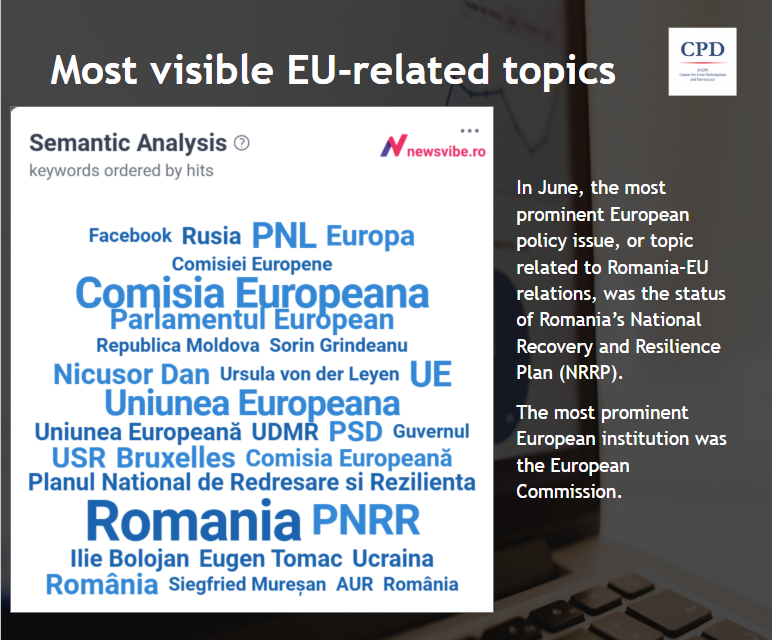
Among all European policy themes, one subject clearly stood above the others: Romania’s National Recovery and Resilience Plan (NRRP/PNRR).
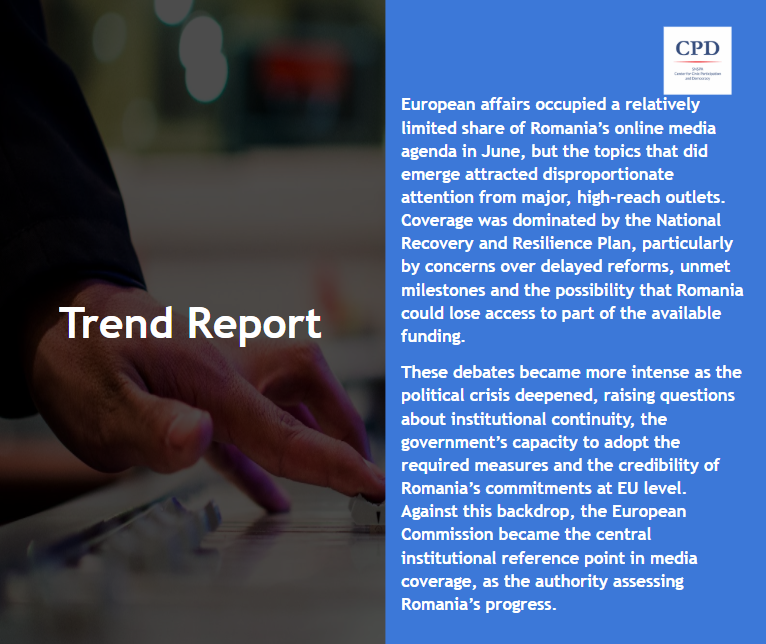
The discussion was driven not simply by the programme itself, but by growing concerns surrounding:
- delayed reforms,
- unmet milestones,
- implementation capacity,
- and the possibility of Romania losing access to European funding.
The report shows that the country’s domestic political crisis significantly intensified these debates.
Rather than treating the NRRP as an isolated administrative issue, media narratives increasingly connected it to broader questions about governmental stability and Romania’s credibility as a European partner.
 The European Commission became the central institutional actor
 The European Commission became the central institutional actor
One of the report’s most revealing findings concerns institutional visibility.
Although many European actors appeared throughout the monitoring period, the European Commission emerged as the primary institutional reference point in Romanian online coverage.
This reflects an important shift in framing.
The Commission was presented less as a distant European bureaucracy and more as the institution responsible for evaluating Romania’s reform progress and safeguarding the proper use of European funds.
As political uncertainty increased, the Commission effectively became the benchmark against which Romania’s administrative performance was assessed.
A surprisingly positive narrative
Despite the highly polarized political environment, sentiment analysis reveals an important nuance.
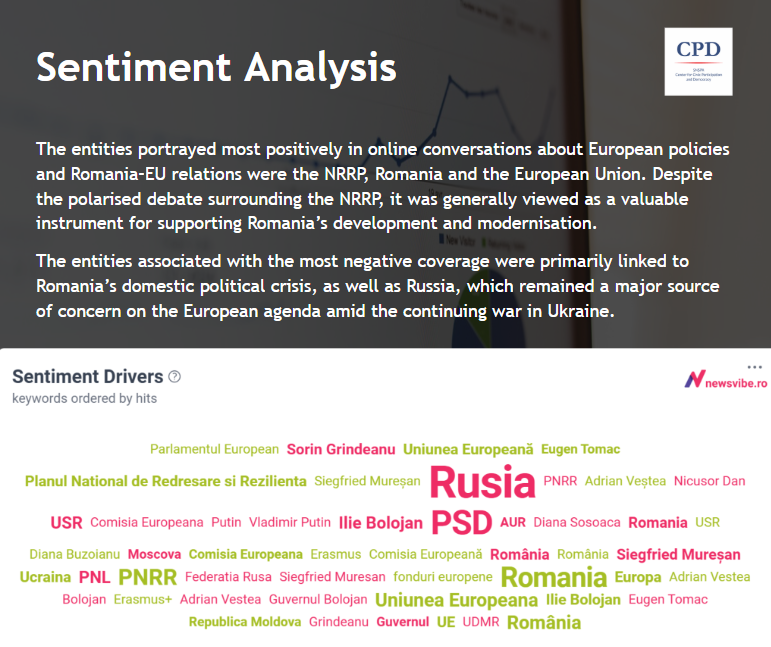
The entities receiving the most positive associations were:
- the NRRP,
- Romania,
- and the European Union itself.
This suggests that criticism was directed primarily toward implementation rather than toward European integration itself.
In other words, the debate questioned Romania’s ability to deliver reforms – not the value of European cooperation.
The strongest negative associations, by contrast, were linked to the domestic political crisis and to Russia, whose continued role in the war against Ukraine remained a major driver of European security discussions.
Beyond politics: a debate about capacity
The findings indicate that June’s online conversation was ultimately less about Brussels and more about governance.
The European Union served as the framework through which broader concerns about administrative capacity, institutional continuity and political credibility were expressed.
This is an important distinction.
European policies became relevant not because they were abstract policy discussions, but because they directly intersected with Romania’s ability to secure funding, implement reforms and maintain trust within the European Union.
The articles published on civicparticipation.ro solely reflect the views of their authors and do not represent SNSPA’s official position.