

Summary
The relationship between online visibility and public attention is often more complex than it appears.
A country may dominate news coverage for an entire year without generating the highest levels of public curiosity. Conversely, a country with relatively limited media visibility can suddenly become the focus of intense public interest if a major geopolitical event captures collective attention.
The latest Digital Dynamics analysis conducted by the Center for Civic Participation and Democracy (CPD) illustrates this phenomenon through a comparative assessment of the United States, Ukraine, Russia and Iran in Romania’s online ecosystem throughout 2025.
The findings reveal some divergence between media visibility and Google search behavior, offering valuable insights into how audiences consume and react to international affairs.
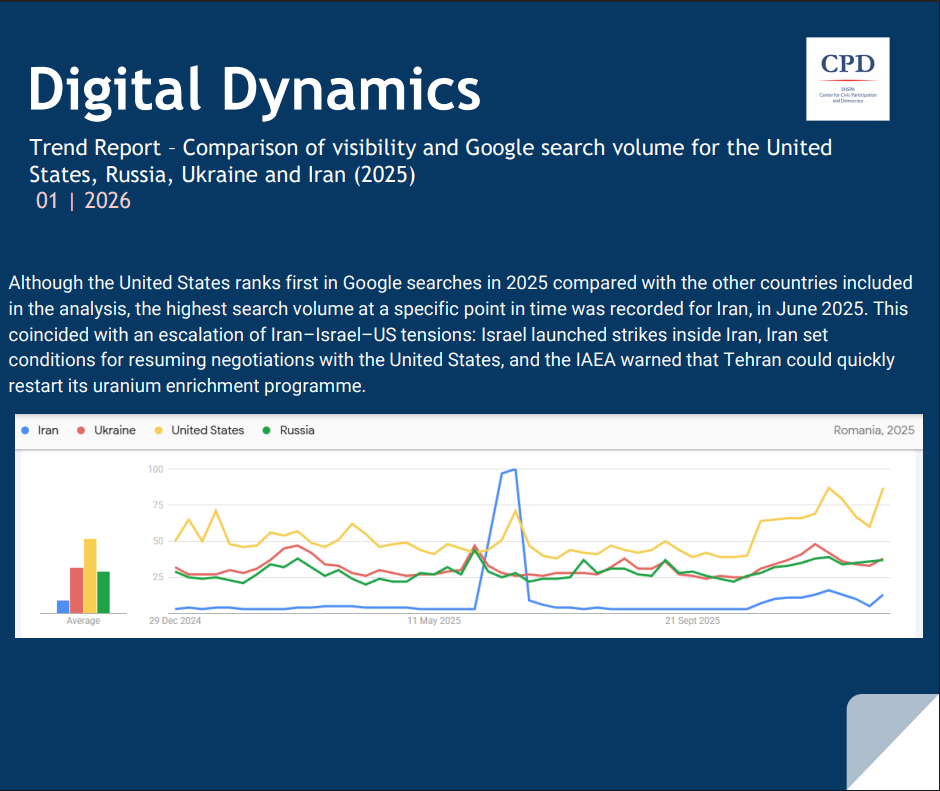
Iran and the power of sudden escalation
Although Iran ranked last among the four countries in overall visibility, it generated the single highest Google search peak recorded during the entire year.
The spike occurred in June 2025, when tensions involving Iran, Israel and the United States intensified simultaneously, which created a surge in news broadcasts.
Israeli strikes inside Iran, renewed discussions about nuclear negotiations and warnings regarding uranium enrichment created a perfect storm of uncertainty. Rather than following a long-running story, audiences were suddenly confronted with the possibility of a major regional escalation whose consequences were difficult to predict.
This distinction is crucial.
Media visibility reflects what journalists, institutions and content creators discuss over extended periods. Search behavior reflects what citizens urgently want to understand at specific moments.
The Iranian case demonstrates that public attention is often driven not by permanence, but by surprise.
The United States remains the dominant reference point
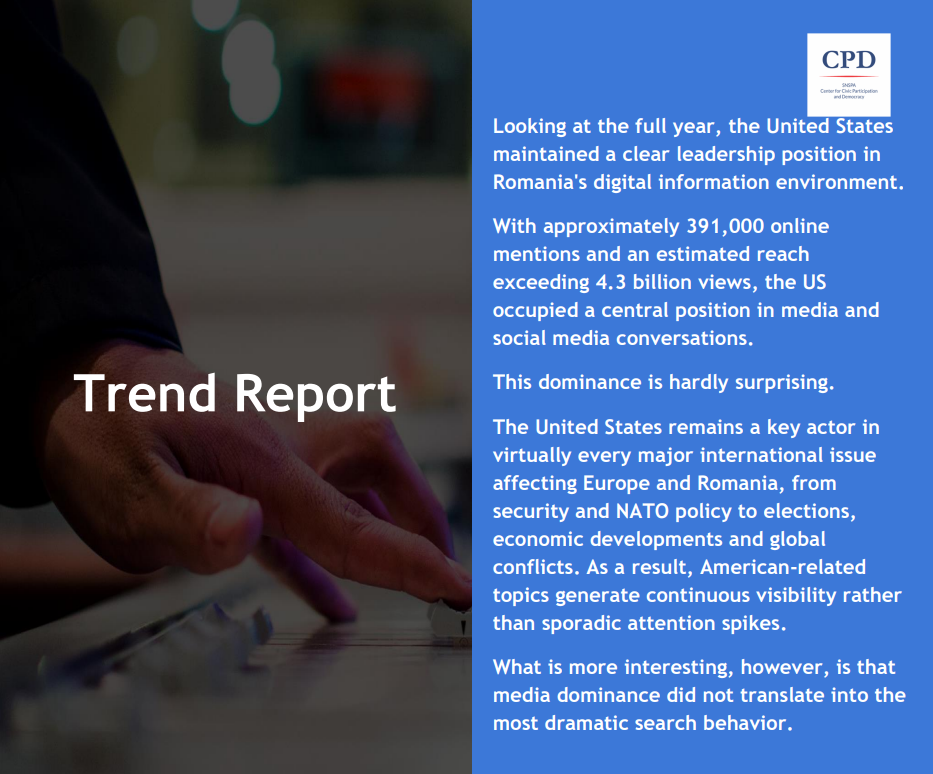
Looking at the full year, the United States maintained a clear leadership position in Romania’s digital information environment.
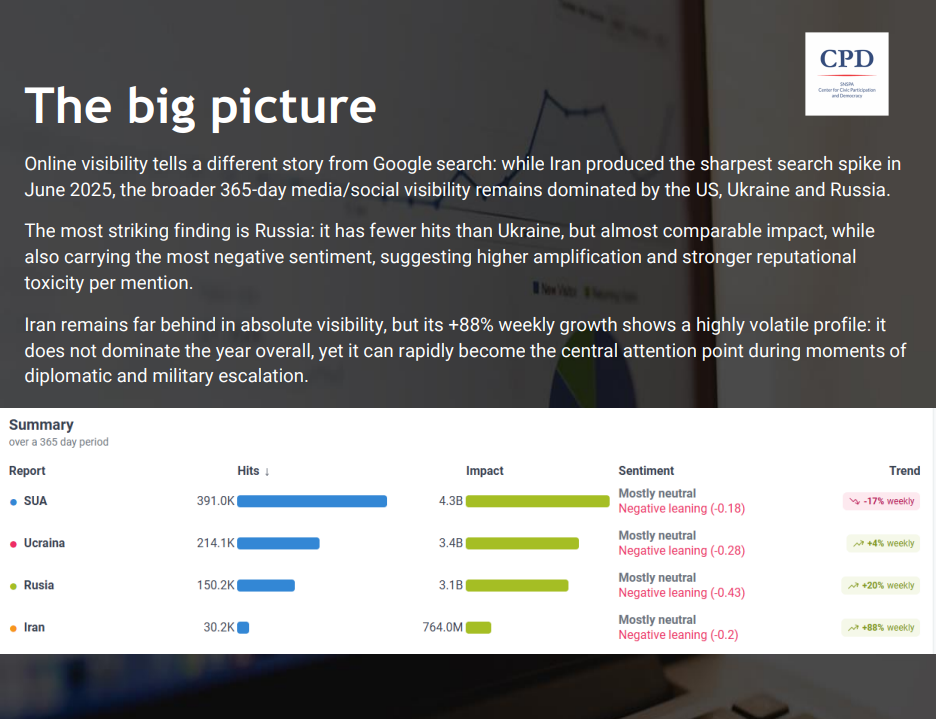
With approximately 391,000 online mentions and an estimated reach exceeding 4.3 billion views, the US occupied a central position in media and social media conversations.
This dominance is hardly surprising.
The United States remains a key actor in virtually every major international issue affecting Europe and Romania, from security and NATO policy, to economic developments and global conflicts. As a result, American-related topics generate continuous visibility rather than sporadic attention spikes.
What is more interesting, however, is that media dominance did not translate into the most dramatic search behavior.
 War in Ukraine: from Breaking News to normalization
 War in Ukraine: from Breaking News to normalization
The data also highlights a transformation in the way the war in Ukraine is perceived.
Ukraine remained one of the most visible geopolitical topics throughout 2025, generating more than 214,000 mentions and an estimated reach of 3.4 billion views.
Yet despite this substantial visibility, Ukraine did not produce search dynamics comparable to those associated with Iran’s June escalation.
This suggests a process that communication researchers frequently observe during prolonged crises: normalization.
The war remains highly important, but audiences have become accustomed to its presence in the information environment. As a result, major developments are more likely to reinforce existing attention patterns than to generate entirely new waves of curiosity.
Ukraine continues to command visibility, but increasingly as a structural topic rather than a disruptive one.
Perhaps the most intriguing finding concerns Russia.
Russia generated significantly fewer mentions than Ukraine throughout the year. Nevertheless, its projected impact reached nearly the same level, exceeding 3.1 billion views.
In practical terms, every mention of Russia appears to travel further.
This suggests stronger amplification dynamics and greater engagement potential per individual piece of content. Russia occupies a particularly influential position in conversations related to security, military developments and geopolitical tensions, allowing its visibility to punch above its numerical weight.
The sentiment data reinforces this observation.
Among the countries analyzed, Russia recorded the strongest negative sentiment score, indicating that it remains the most reputationally toxic actor in the Romanian online environment.
Visibility alone does not explain influence. Amplification and emotional intensity matter as well.
Attention as increasingly volatile
One of the broader lessons emerging from the analysis is that digital attention has become highly reactive.
The traditional assumption that visibility follows geopolitical importance only partially explains contemporary information dynamics.
Instead, attention increasingly follows a combination of:
- perceived risk;
- uncertainty;
- escalation potential;
- emotional intensity;
- and novelty.
This explains why Iran, despite remaining far behind the United States, Ukraine and Russia in annual visibility, recorded the strongest growth trend and the most dramatic search spike.
In the digital age, audiences are not merely consuming information. They are constantly reassessing which events might suddenly change the global landscape.
The articles published on civicparticipation.ro solely reflect the views of their authors and do not represent SNSPA’s official position.