

Summary
In the past month, Romania’s online space has once again reflected the gravitational pull of the war in Ukraine. But beyond headlines and daily news cycles, what does the data reveal about how Russia and Ukraine actually circulate in the Romanian digital ecosystem?
The February 2026 Digital Dynamics report offers a comparative snapshot of visibility, projected impact, and sentiment drivers associated with the two state actors. The results show a landscape that is not symmetrical, neither in volume nor in narrative intensity.
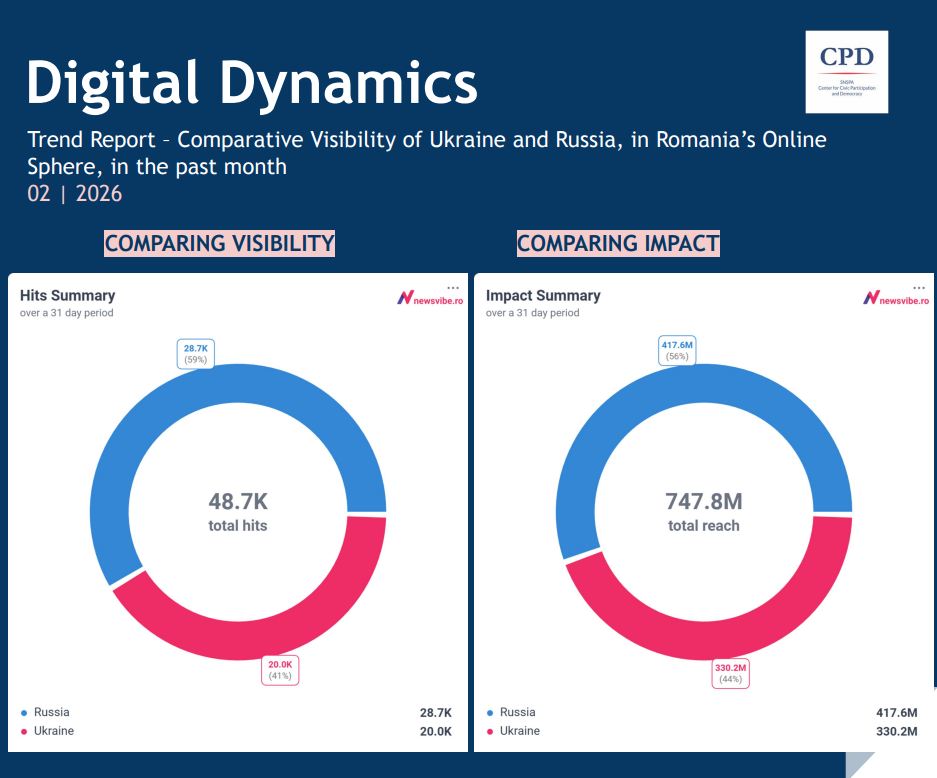
The first layer of analysis compares simple mention counts with projected reach.
Over a 31-day period, Russia generated approximately 28.7K online mentions, while Ukraine recorded around 20K mentions. In raw visibility terms, Russia leads by a noticeable margin.
However, when we shift to projected impact – the estimated reach of those mentions – the gap narrows. Russia accumulates roughly 417.6 million in reach, compared to Ukraine’s 330.2 million. Combined, the two exceed 747 million total projected impressions in Romanian online sources over just one month.
This distinction matters.
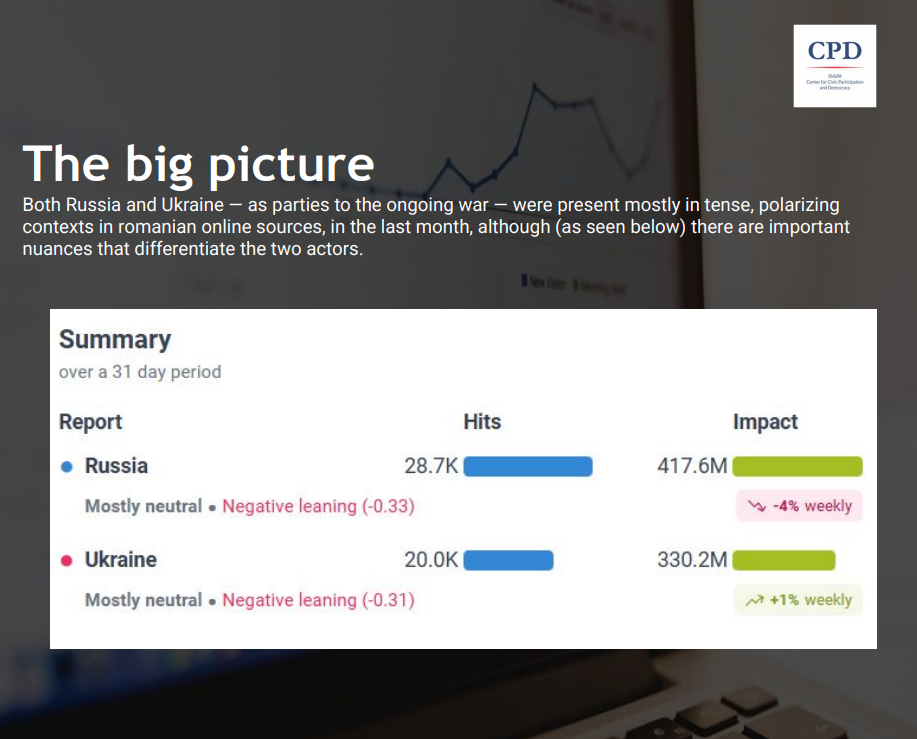
While Russia dominates in frequency, the impact difference is proportionally smaller. Ukraine’s coverage, though less frequent, appears concentrated in high-reach sources or amplified narratives. The data suggests that Ukraine’s digital footprint may be more strategically amplified, even if less volumetrically dominant.
Both actors appear in predominantly tense and polarizing contexts- unsurprising given the ongoing war. Yet sentiment scoring reveals nuance.
- Russia: mostly neutral, but with a negative leaning (-0.33)
- Ukraine: mostly neutral, with a slightly softer negative leaning (-0.31)
The difference is subtle but consistent: Russia’s digital presence carries marginally heavier negative weight.
Interestingly, short-term trend indicators show divergence. Russia’s impact registered a weekly decline (-4%), while Ukraine experienced a slight positive uptick (+1%). This may indicate narrative fatigue regarding Russia-related content or temporary shifts in topical focus.
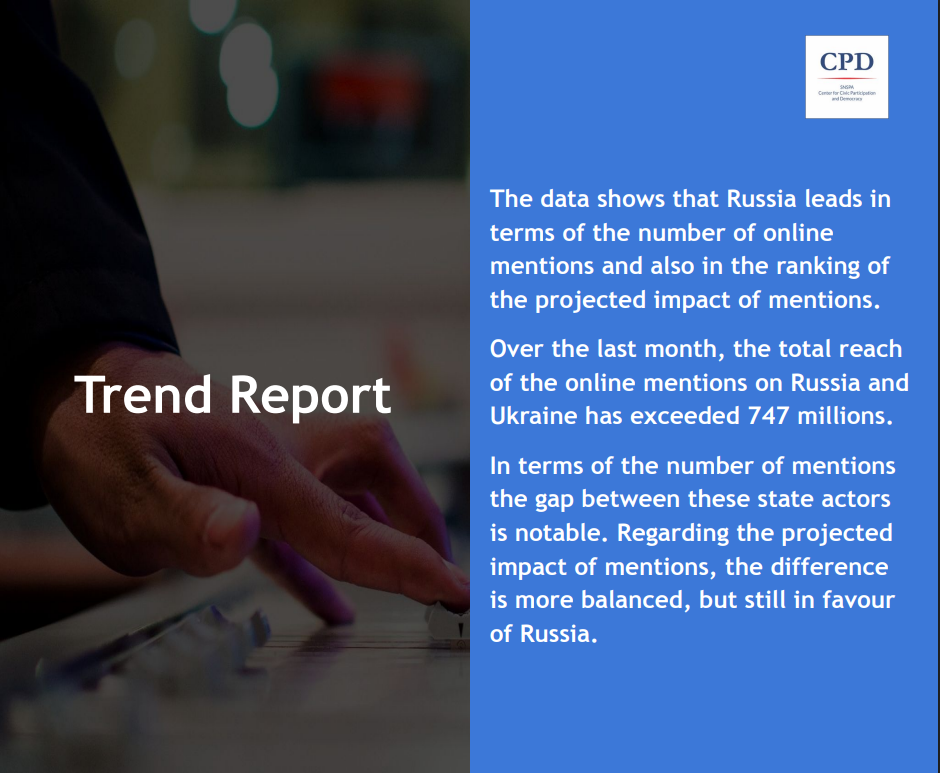
The semantic clustering associated with Ukraine shows a pattern: negative contexts involving Ukraine are heavily anchored around Russia, Moscow, and Vladimir Putin.
In other words, Ukraine’s negative framing rarely exists in isolation. It is structurally embedded within references to Russian actions, leadership, or geopolitical pressure. Ukraine appears discursively reactive – its negativity is relational.
This reinforces a broader dynamic: Ukraine is framed primarily through the war lens, with Russia serving as the narrative axis.
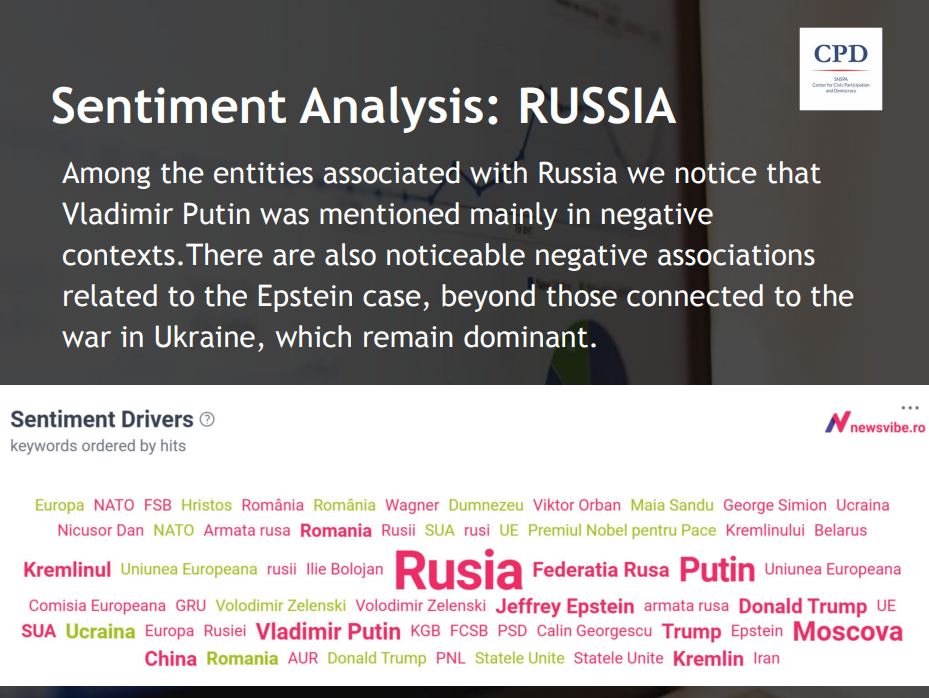
Russia’s semantic ecosystem is wider and more diversified.
While war-related themes remain dominant, another noteworthy dimension appears: negative associations linked to the Epstein case. These associations operate beyond the Ukraine conflict narrative, indicating that Russia’s digital image in Romania is influenced by cross-topic contamination effects – geopolitical and reputational overlaps extending into broader global controversies.
Moreover, Vladimir Putin emerges as a central negative anchor in Russia-related content. Unlike Ukraine, whose negative framing is often situational, Russia’s negative framing is frequently personalized.
This suggests that Russia’s digital representation is less about a single event and more about a cumulative reputational layer.
Both actors circulate in an online environment characterized by tension, polarization, and geopolitical framing. Neutral coverage dominates numerically, but the emotional undertone is unmistakably strained.
The Romanian digital sphere does not treat Russia and Ukraine symmetrically – yet neither is framed purely through binary moral polarization. Instead, the ecosystem reflects:
- Volume asymmetry (Russia leads)
- Impact compression (gap narrows in reach)
- Sentiment convergence (both slightly negative)
- Narrative differentiation (Ukraine war-centric, Russia multi-contextual)
The result is a layered digital battlefield where visibility, impact, and sentiment do not align perfectly.