

Summary
In the spring of 2026, Romania’s online conversation experienced a notable geopolitical shift.
In the last years, Ukraine dominated the regional information landscape, remaining the central reference point for war-related media coverage, strategic debates, and online polarization. But new data from the latest Digital Dynamics report conducted by the Center for Civic Participation and Democracy (CPD) shows that this dynamic changed between March 1 and May 15, 2026.
For the first time in recent monitoring cycles, Iran surpassed Ukraine in both online visibility and projected impact inside Romania’s digital ecosystem.
And the reasons go far beyond simple media volume.
A shift in attention dynamics
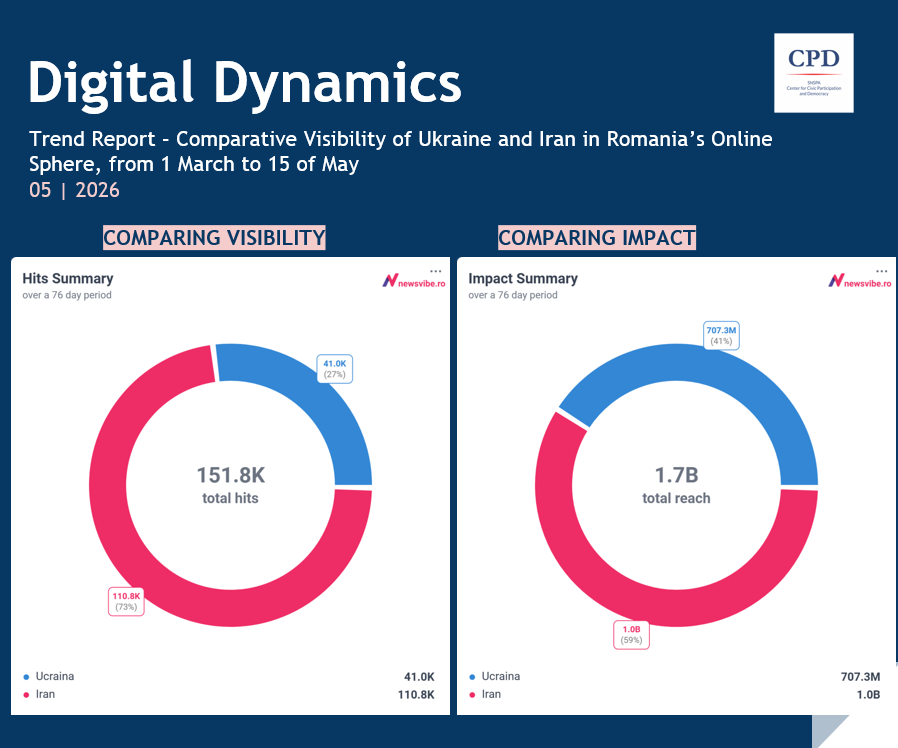
The comparative data is striking.
Over the monitored 76-day period:
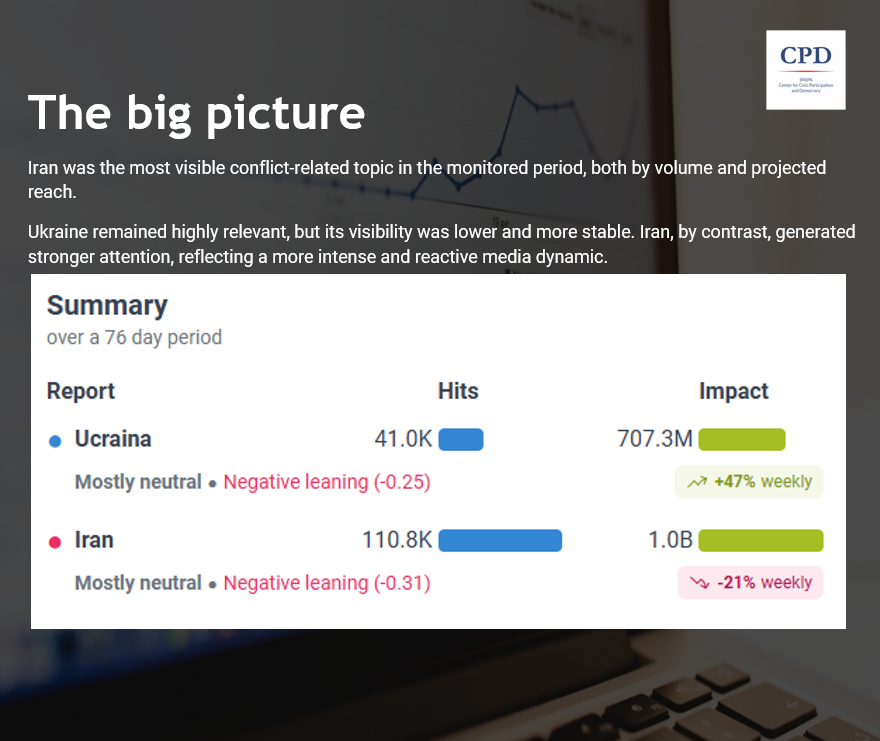
- Iran generated 110.8K mentions
- Ukraine generated 41K mentions
In terms of projected reach:
- Iran exceeded 1 billion estimated views
- Ukraine accumulated approximately 707 million
The gap is substantial – not marginal.
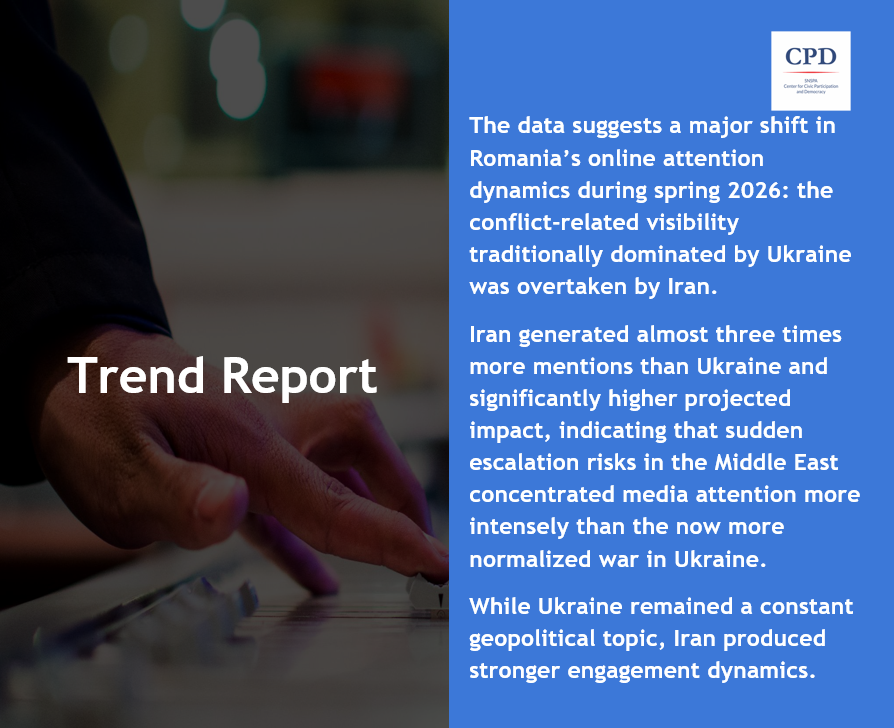
The data suggests that Romanian online attention was captured far more intensely by developments in the Middle East than by the ongoing war in Ukraine during this period.
This does not mean Ukraine disappeared from the agenda. On the contrary, Ukraine remained a constant and highly visible geopolitical subject. But its media presence became comparatively more stable and normalized.
Iran, by contrast, generated a much more reactive information environment.
The logic of escalation
One of the most important findings of the analysis is related to the psychology of digital attention.
Ongoing wars eventually develop a form of narrative routine. Even when violence continues, public and media attention gradually stabilizes around familiar patterns, actors, and expectations.
Escalation risks, however, disrupt this equilibrium.
The Iranian topic entered Romanian online discourse through a logic of volatility:
- fears of regional expansion,
- the possibility of wider military escalation,
- and uncertainty regarding global and national economic consequences.
Digital ecosystems react strongly to unpredictability.
This explains why Iran generated not only higher visibility, but also higher reach dynamics than Ukraine during the analyzed interval.
Stable conflict vs. reactive conflict
The contrast between the two cases becomes even clearer when examining momentum trends.
Despite dominating overall visibility, Iran registered a 21% weekly decline in projected impact toward the end of the monitored period.
Ukraine, meanwhile, recorded a 47% weekly increase.
This suggests two different information trajectories:
- Iran produced an intense spike-driven attention cycle;
- Ukraine maintained a more persistent and structurally resilient presence.
In strategic communication terms, Iran functioned as a “reactive crisis topic,” while Ukraine remained a “structural geopolitical topic.”
This distinction matters because reactive attention is usually more emotionally intense but less sustainable over time.
The architecture of sentiment
The sentiment analysis reveals even deeper differences between the two conversations.
Ukraine: resilience vs. aggression
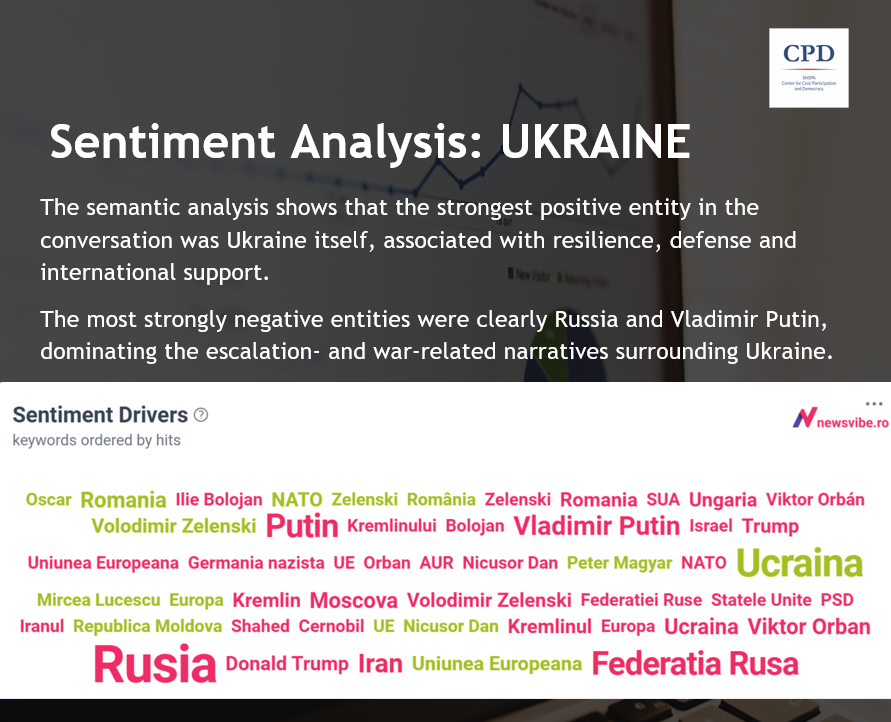
In Ukraine-related discourse, the strongest positive entity was Ukraine itself. The semantic associations clustered around:
- resilience,
- defense,
- international support,
- NATO,
- and European alignment.
Negative associations, meanwhile, were dominated overwhelmingly by:
- Russia,
- Vladimir Putin,
- Kremlin-related references,
- and escalation narratives.
This indicates a relatively coherent moral architecture inside the Romanian online conversation regarding Ukraine.
Ukraine is framed positively as the victim-resistance actor; Russia remains the primary negative anchor.
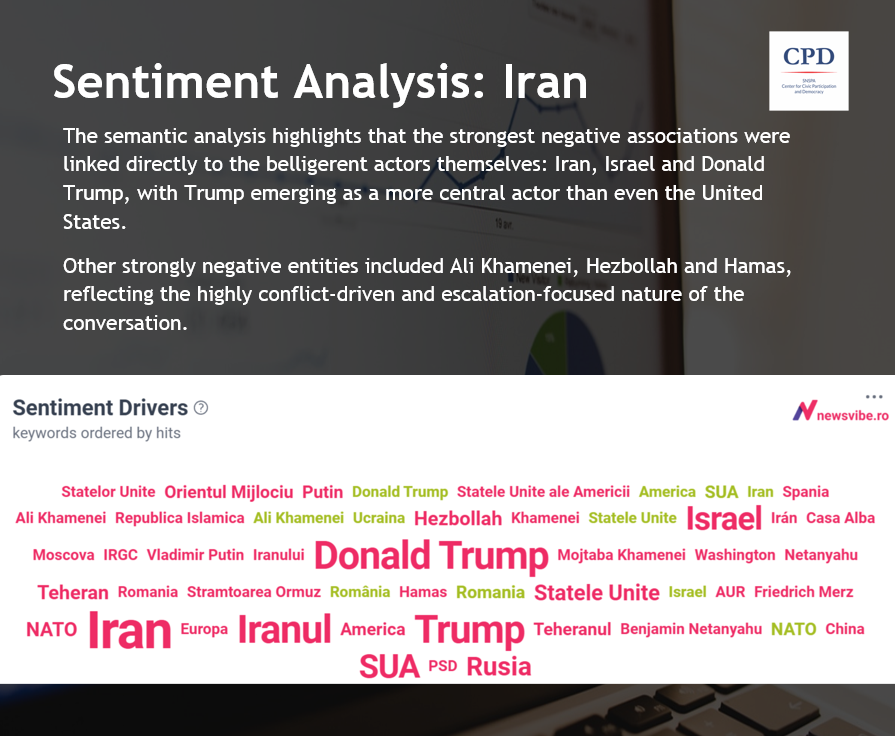
Iran: conflict without a stable moral center
The Iranian conversation looked fundamentally different.
The strongest negative entities were not peripheral actors, but the belligerents themselves:
- Iran,
- Israel,
- and US/Donald Trump.
Interestingly, Donald Trump emerged as a more central conversational actor than even the United States.
Other strongly negative semantic nodes included:
- Ali Khamenei,
- Hezbollah,
- Hamas,
- and escalation-related Middle East actors.
Unlike the Ukraine discourse – which retains a relatively stable polarity structure – the Iran-related conversation appears fragmented, conflict-driven, and heavily centered around escalation dynamics rather than moral alignment.
In other words, the romanian digital conversation about Ukraine is structured around a recognizable geopolitical narrative, while the Iran conversation is structured around instability itself.
What the data actually tells us
The most important conclusion is not simply that Iran became more visible than Ukraine.
The deeper conclusion is that online ecosystems prioritize:
- uncertainty,
- escalation potential,
- emotional immediacy,
- and perceived systemic risk.
Digital visibility is not static.
It is reactive to the emotional architecture of international events.
The spring 2026 data shows that Romania’s online sphere responded more intensely to the possibility of rapid regional destabilization in the Middle East than to the continuation of a war that, despite its scale, has become partially normalized in media consumption patterns.
This does not diminish the importance of Ukraine.
Instead, it reveals how digital attention evolves: not necessarily according to geopolitical significance alone, but according to the intensity of perceived disruption.
Why it matters
For analysts, policymakers, journalists, and strategic communicators, these dynamics are increasingly important.
Modern geopolitical influence is no longer shaped only through military capabilities or diplomatic positioning. It is also shaped through:
- attention cycles,
- narrative intensity,
- semantic associations,
- and emotional amplification inside digital ecosystems.
Understanding how these architectures evolve is essential for interpreting not only public discourse, but also the broader information environment surrounding international crises.
The battlefield of visibility has become almost as dynamic as the geopolitical battlefield itself.
The articles published on civicparticipation.ro solely reflect the views of their authors and do not represent SNSPA’s official position.