

Artificial intelligence has moved beyond its role as a productivity tool and is now shaping how people judge information and credibility. Data from the latest wave of the AI Public Opinion Tracker show that a growing share of Americans rely on AI assistants not only for work and study, but also as gateways to news and information, placing these tools at the center of everyday communication practices.
These findings come from the latest survey conducted by the College of Information and Communications at the University of South Carolina. The research is co-initiated and analytically coordinated by Dan Sultănescu, Research Director at CPD SNSPA. The project tracks how public use of AI is evolving over time and what this shift means for trust, journalism and democratic processes, at a moment when AI is becoming embedded in routine decision-making rather than treated as an experimental technology.
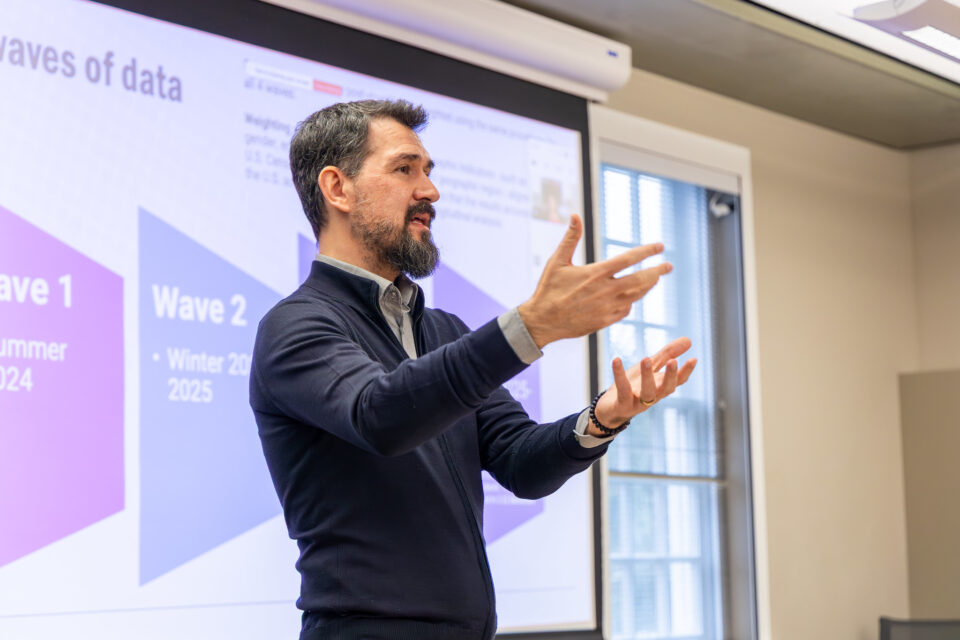
AI’s shift from novelty to default
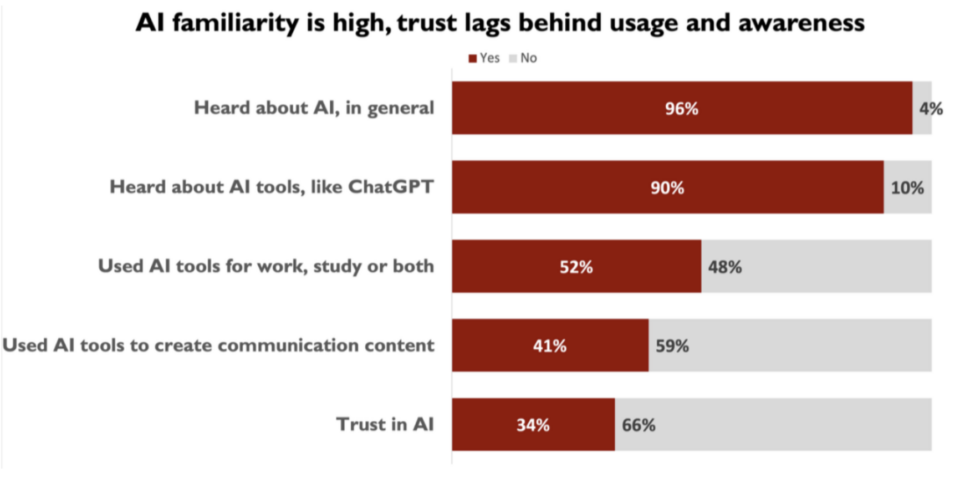
Data from the most recent wave of the study clearly show that AI assistants have moved beyond the experimental phase. For a significant share of the US adult population, AI has become an implicit component of cognitive work, used for information seeking, writing, organizing ideas and decision support. This “accelerated normalization” of AI represents one of the main interpretive axes of the survey series coordinated by Dan Sultănescu.
Beyond a simple reading of AI adoption rates (which are very high), what emerges clearly from the latest wave of the research, based on data from Winter 2025–2026, is the growing authority of AI tools. These tools are no longer perceived merely as technical instruments; they have also become mediators of credibility, information visibility and intellectual productivity.
Work & the pressure of skills reconfiguration
A distinctive feature of this research series is its analysis of how AI is experienced differently depending on occupational position. The surveys in this series have consistently shown that the pressure generated by AI is not expressed solely as an immediate threat of job loss, but also as a continuous need for adaptation and reskilling.
In fields associated with knowledge production and communication in particular, AI tools are perceived both as accelerators of work and as factors intensifying symbolic and professional competition.
Access to information – transformed by AI
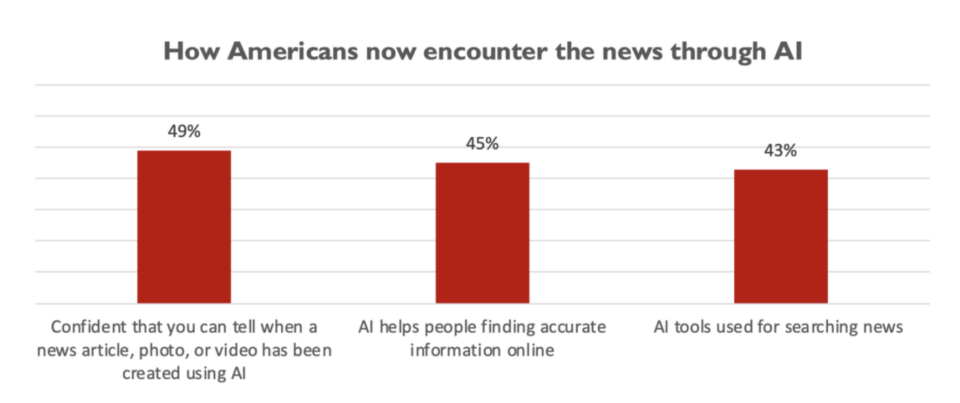
Across three measures, the data indicate a structural shift toward AI-mediated news engagement, with AI assistants increasingly serving as gateways to information:
• 43% of Americans report using AI tools to search for news
• 45% say AI helps them find accurate information online
• Nearly half of respondents are confident they can identify AI-generated media
A major pillar of the research coordinated by Dan Sultănescu focuses on the relationship between AI and journalism. The data point to a persistent tension: the public acknowledges the efficiency of AI in journalistic processes, yet rejects the idea of fully delegating journalistic labor and editorial responsibility.
In this context, the survey results indicate an emerging public consensus around transparency. A majority of respondents consider it mandatory to disclose the use of AI in the production or editing of journalistic content. From a democratic perspective, this requirement also functions as a mechanism to support the public’s ability to distinguish between human-produced content and automatically generated content.
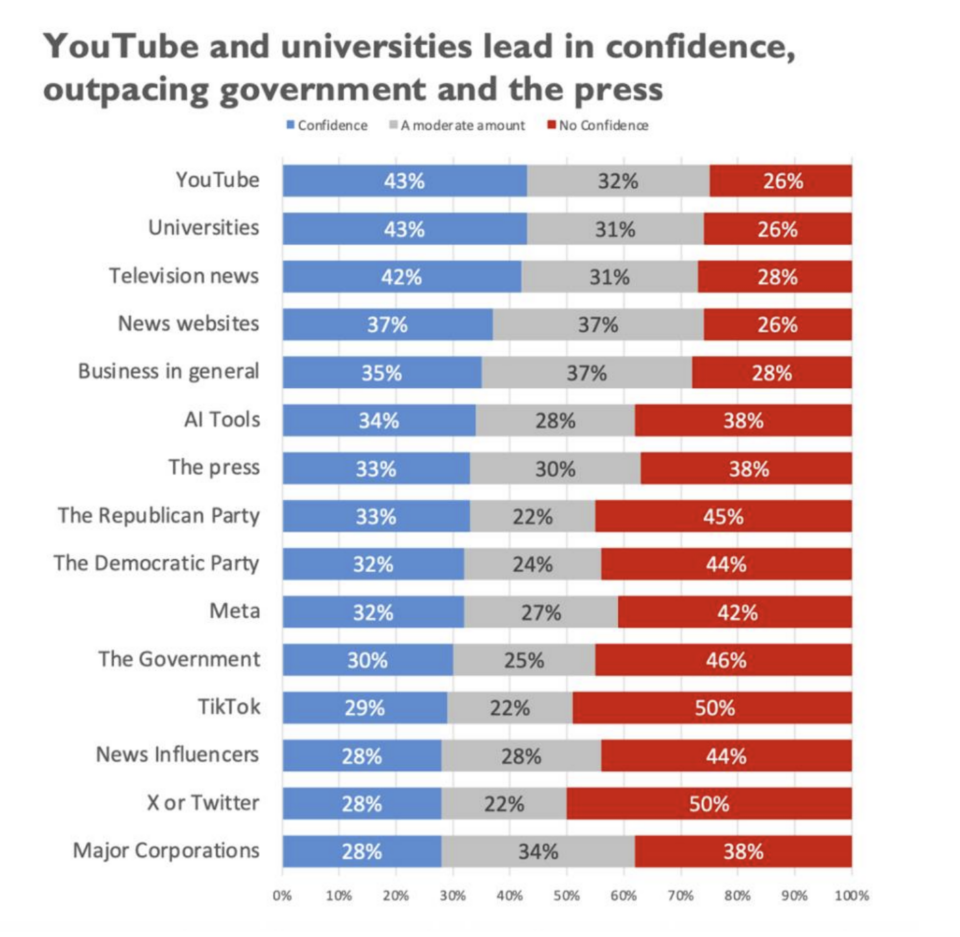
Moreover, reinforcing findings from previous waves of the study, the survey reveals higher levels of trust in AI tools than in traditional media, as well as in government, corporations, or media influencers. The trust ranking is dominated by YouTube and universities. TikTok and X lead the “no confidence” rankings.
Exposure vs skepticism
Under the coordination of Dan Sultănescu, the survey introduces a relevant analytical instrument – the AI Exposure Index – which synthesizes the relationship between AI use, trust and risk perception. The results reveal a structural division of the public between an “AI-exposed” segment, characterized by high levels of use and trust, and a more skeptical segment, which is more cautious and more fearful.
This polarization is not purely technological; it overlaps with broader divides in institutional trust and media consumption. One of the central messages of the research series is that familiarity with AI can, counterintuitively, become a source of vulnerability by reducing critical vigilance.
What’s next
As AI becomes an integral part of the information ecosystem, the key issue is no longer whether it will be used, but how it is understood, regulated and responsibly integrated into everyday usage flows. The research coordinated by Dan Sultănescu provides a solid empirical framework for this discussion, one that will shape the relationship between technology, communication and democracy in the years ahead.
The full study, as well as previous editions, can be accessed here:
https://www.sc.edu/study/colleges_schools/cic/initiatives/ai/ai_index/index.php